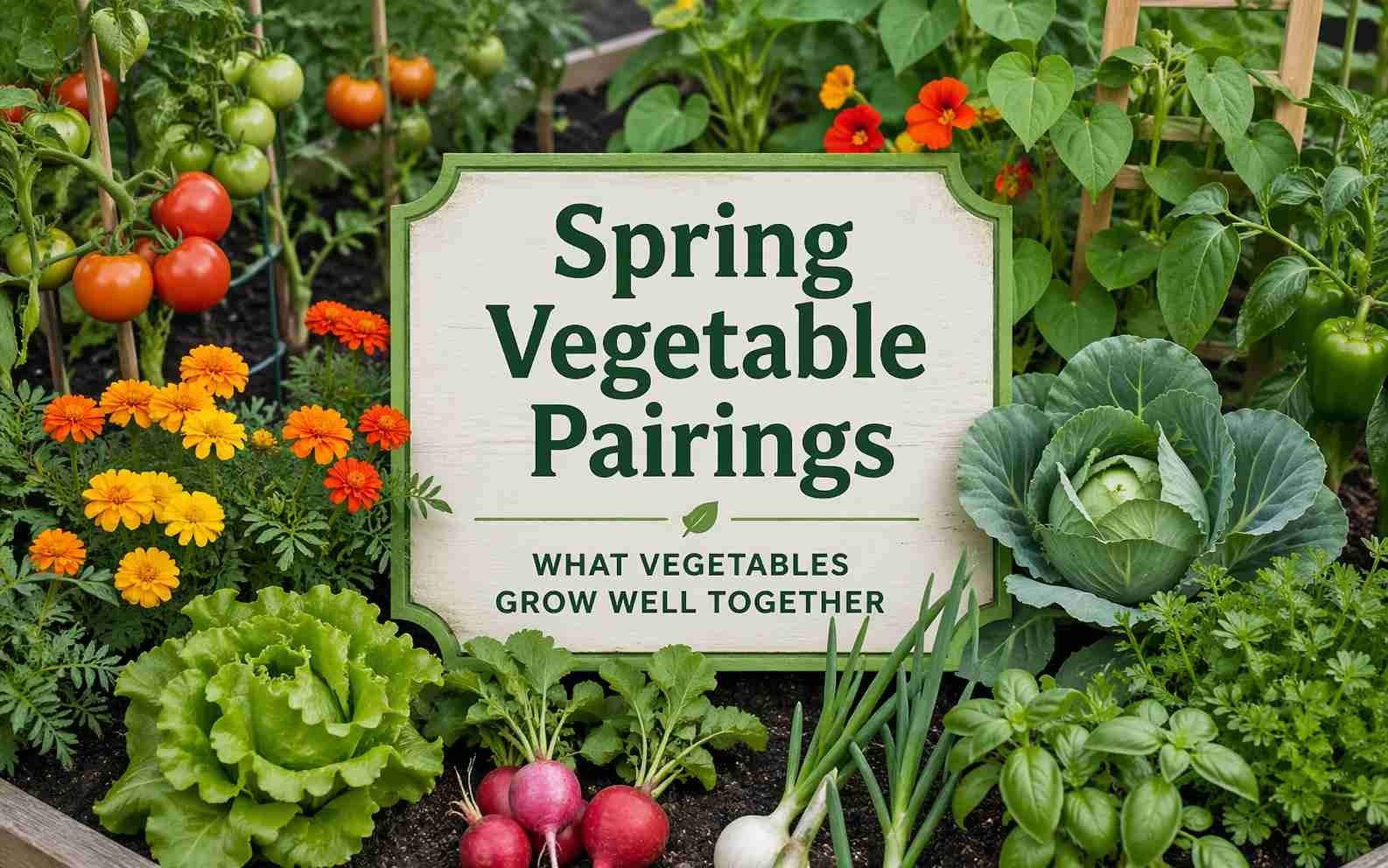
Spring Vegetable Pairings Guide: Best Companion Planting
Spring is when a vegetable garden wakes up hungry and full of promise. The smartest way to feed that momentum is through spring vegetable pairings, growing crops together that naturally support each other.
Done right, these pairings improve growth, reduce pests, and make better use of every inch of soil. You should think of it as planting with intention instead of habit.
These pairings work by matching plants that support each other’s growth cycles. Some improve soil nutrients, others deter pests naturally, while a few provide shade or structural balance. When planned correctly, spring vegetable pairings create healthier plants, higher yields, and more efficient use of garden space without extra chemicals.
Spring vegetable pairings improve the garden by:
- Enhancing soil nutrients through plant synergy.
- Naturally reducing pests without chemicals.
- Optimizing space through smart plant placement.
- Supporting stronger growth and higher yields.
What Is Companion Planting? (And Why It Matters)
Companion planting vegetables means growing certain crops together to improve growth, repel pests, and increase yields naturally. The right pairings can reduce pests, boost pollination, and make better use of your garden space.
Placing certain crops together so they:
- Repel pests naturally
- Improve soil health
- Boost pollination
- Increase overall yield
It’s not guesswork. It’s a quiet partnership happening below and above the soil. Like the roots sharing space, leaves shaping light, and scents confusing pests. For beginners, this is one of the simplest ways to get better results without chemicals.
“Companion planting is a great way to use space efficiently in the garden, plant your vegetables and flowers in mutually beneficial arrangements, and even protect your most prized plants from insects.”
- According to the University of Minnesota Extension
What Vegetables Grow Well Together?
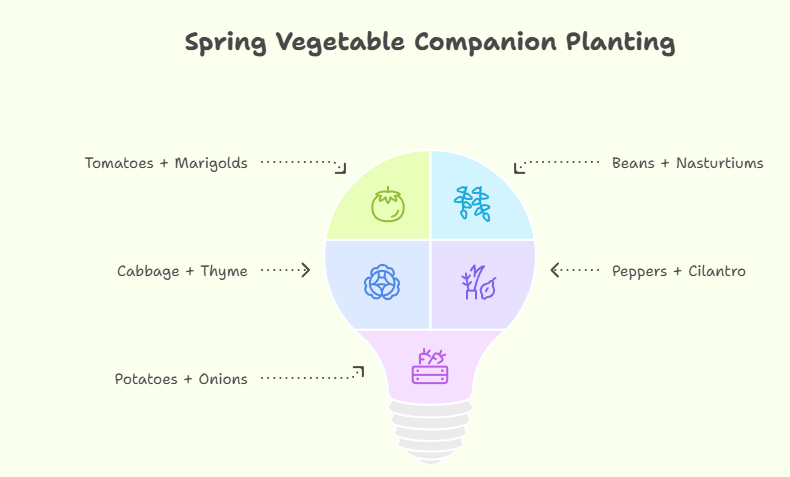
If you just want the essentials, here are proven spring vegetable pairings:
- Tomatoes + Marigolds → pest control
- Beans + Nasturtiums → trap pests
- Cabbage + Thyme → repel worms
- Peppers + Cilantro → shade + pest balance
- Potatoes + Onions → deter beetles
These plant combinations form the backbone of companion planting for beginners.
Vegetable Companion Planting Chart
Here’s a quick-reference vegetable companion planting chart you can use right away:
| Vegetable | Best Companion | Benefit |
| Tomato | Marigold | Repels nematodes |
| Beans | Nasturtium | Attracts pests away |
| Cabbage | Thyme | Repels cabbage worms |
| Pepper | Cilantro | Prevents bolting |
| Potato | Onion | Repels beetles |
| Carrot | Onion | Reduces carrot flies |
| Lettuce | Radish | Improves space use |
This chart alone answers most “what vegetables grow well together” questions. So, you can always have a quick look here.
10 Best Spring Vegetable Pairings (That Actually Work)
These spring vegetable pairings aren’t random combinations. Each one is backed by how plants interact with pests, soil biology, and even sunlight. If you’re exploring companion planting vegetables, start from here. These are reliable, beginner-friendly, and proven across seasons.
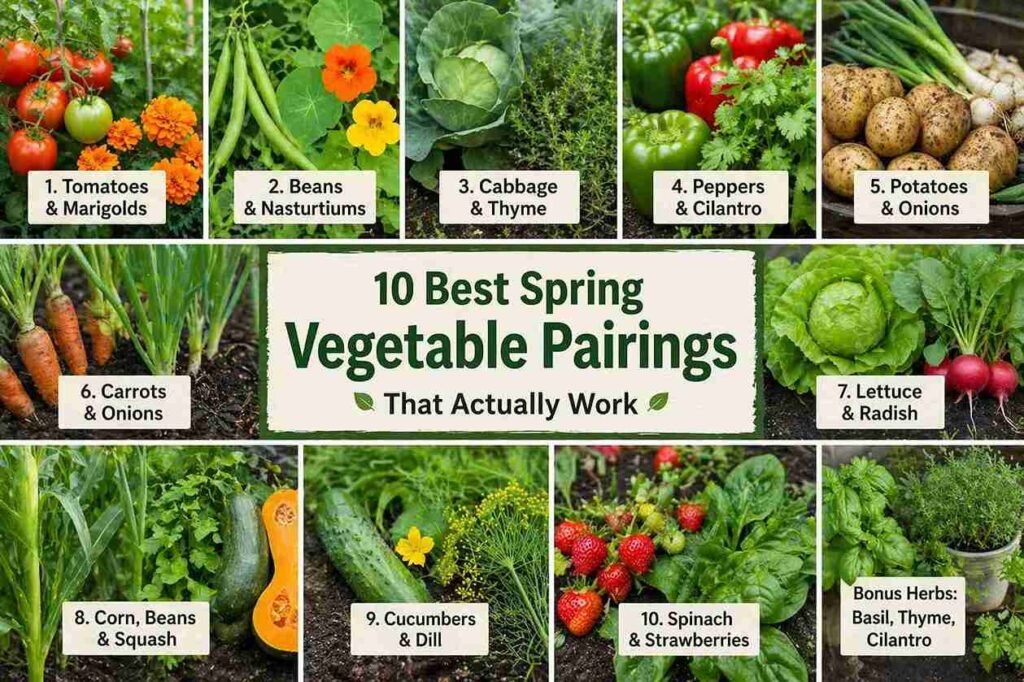
1. Tomatoes and Marigolds (Natural Pest Shield)
Tomatoes and Marigolds are one of the most trusted best companion plants for vegetable combinations.
Marigolds release natural compounds (like alpha-terthienyl) that help suppress root knot nematodes, a common soil pest that weakens tomato roots. Above ground, they also act as a distraction for aphids, thrips, and mites.
From a gardener’s view, marigolds don’t just protect; they act like a living border patrol. Plant them around or between tomatoes for stronger, healthier growth.
Best tip: You can use French or African marigolds and plant them early so they establish before pests arrive.
2. Beans and Nasturtiums (Trap Crop Strategy)
If you’re learning companion planting for beginners, this pairing teaches one powerful idea: sacrifice one plant to save another.
Nasturtiums attract aphids, bean beetles, and whiteflies, pulling them away from your beans. Meanwhile, they also invite pollinators when pest pressure is low.
They spread quickly, acting as a living ground cover that reduces weeds and protects soil moisture.
Bonus: Nasturtium flowers are edible, adding both function and flavor to your garden.
3. Cabbage and Thyme (Defense Against Leaf Destroyers)
Cabbage family plants (brassicas) are magnets for pests like:
- Cabbage worms’
- Cabbage loopers’
- Cabbage maggots’
Thyme releases aromatic oils (notably thymol) that confuse these pests and reduce damage.
While thyme won’t eliminate pests completely, it creates enough interference to slow infestations, buying you time to manage your crop naturally.
Pro tip: You can pair this with row covers for a near-complete organic defense system.
4. Peppers and Cilantro (Shade + Pest Balance)
Peppers and Cilantro pairing works on two levels.
Cilantro helps repel aphids and mites with its strong scent. At the same time, pepper plants provide partial shade, which delays cilantro from bolting in warmer weather.
There’s also a hidden ally here: cilantro attracts beneficial insects like hoverflies, whose larvae feed on aphids.
Result: A balanced micro-ecosystem where pests struggle to take hold.
5. Potatoes and Onions (Underground + Above-Ground Protection)
Potatoes are highly productive but also highly vulnerable. Especially to the Colorado potato beetle.
Onions release sulfur-based compounds that deter:
- Beetles
- Aphids
- Leafhoppers
Because potatoes grow deeper and onions stay shallow, they don’t compete heavily for root space. So, this combo is a smart structural pairing too.
6. Carrots and Onions (Mutual Pest Protection)
This is a two-way defense system.
- Onions repel carrot flies
- Carrots help confuse onion pests
Their scents mask each other, making it harder for insects to locate their target crops. Carrots and Onions pairing is especially useful in spring when pest populations begin to rise. Plant in alternating rows for best results.
7. Lettuce and Radish (Space Optimization Pairing)
Lettuce and Radish – Fast meets slow.
Radishes grow quickly and help break up compacted soil, improving aeration for lettuce roots. By the time lettuce needs more space, radishes are already harvested.
This pairing is less about pest control and more about efficient gardening, making it perfect for:
- Small spaces
- Raised beds
- Succession planting
A great example of vegetable garden pairings beyond pest control.
8. Corn, Beans, and Squash (The Three Sisters Method)
This traditional system is one of the most complete examples of companion planting vegetables:
- Corn provides vertical support
- Beans fix nitrogen into the soil
- Squash acts as ground cover, reducing weeds and moisture loss
Together, they form a self-supporting growing system that improves soil and yield over time.
Corn, Beans, and Squash trio is more than a pairing; it’s a full planting strategy.
9. Cucumbers and Dill (Pollinator Magnet)
Cucumbers rely heavily on pollination for fruit production.
Dill attracts:
- Bees
- Ladybugs
- Parasitic wasps
These beneficial insects improve pollination and help control pests like aphids.
Let some dill flower to maximize its impact; this is when it becomes most attractive to beneficial insects.
10. Spinach and Strawberries (Living Mulch Effect)
Spinach acts as a natural ground cover, helping:
- Retain soil moisture
- Regulate soil temperature
- Suppress weeds
Strawberries benefit from this stable environment, especially during early growth stages. This pairing is ideal for gardeners focused on soil health and moisture conservation.
Vegetable Garden Pairings vs Companion Planting
Not all vegetable garden pairings are about pest control. Some people focus on:
- Harvest timing (fast + slow crops together)
- Space efficiency (deep roots + shallow roots)
- Flavor pairing (kitchen synergy)
Companion planting is more strategic, while general pairings are more flexible.
Companion Planting for Natural Pest Control
One of the biggest strengths of companion planting vegetables is how it reduces pests without relying on synthetic sprays. Instead of fighting your garden, you guide it. You can use plant chemistry, scent, and biodiversity to keep problems in check.
In a well-planned bed, pest control doesn’t feel like intervention. It feels like balance.
How Companion Planting Controls Pests Naturally
Companion planting works through a few quiet but powerful mechanisms:
- Strong scents confuse insects: Many pests locate plants by smell. Herbs like thyme and cilantro release aromatic compounds (like thymol) that mask the scent of nearby crops, making it harder for pests like aphids, cabbage worms, and thrips to find their target.
- Trap crops attract pests away: Some plants act as decoys. For example, nasturtiums draw in aphids and whiteflies, keeping them off your vegetables. This method is especially useful in spring vegetable pairings, when pest populations begin to rise.
- Flowers bring beneficial insects: Not all insects are enemies. Flowers like marigolds and dill attract:
- ladybugs (eat aphids)
- hoverflies (larvae consume soft-bodied pests)
- parasitic wasps (target harmful larvae)
These natural predators help regulate pest populations before they explode.
Best Companion Plants for Natural Pest Control
If you’re looking for the best pairing plants for vegetables, these are some of the most effective:
- Marigold → helps reduce root knot nematodes and deters aphids
- Thyme → repels cabbage worms and loopers
- Cilantro → confuses pests and attracts beneficial insects
- Dill → boosts pollination and supports predator insects
- Nasturtium → acts as a trap crop for multiple pests
These plants don’t eliminate pests completely, but they reduce pressure enough to protect your harvest naturally.
Why This Method Works Long-Term
Unlike chemical control, vegetable pairings planting builds a self-regulating system.
- Improves biodiversity in your garden
- Supports soil microflora and plant health
- Reduces dependency on external inputs
Over time, your garden becomes more resilient. Fewer outbreaks, healthier plants, and a steady balance between pests and predators.
What Not to Plant Together
Not all plants get along. You should avoid these plant combinations:
- Tomatoes + Potatoes → shared diseases
- Beans + Onions → growth inhibition
- Carrots + Dill (mature) → competition
To know what to avoid is just as important as knowing the best spring companion plants.
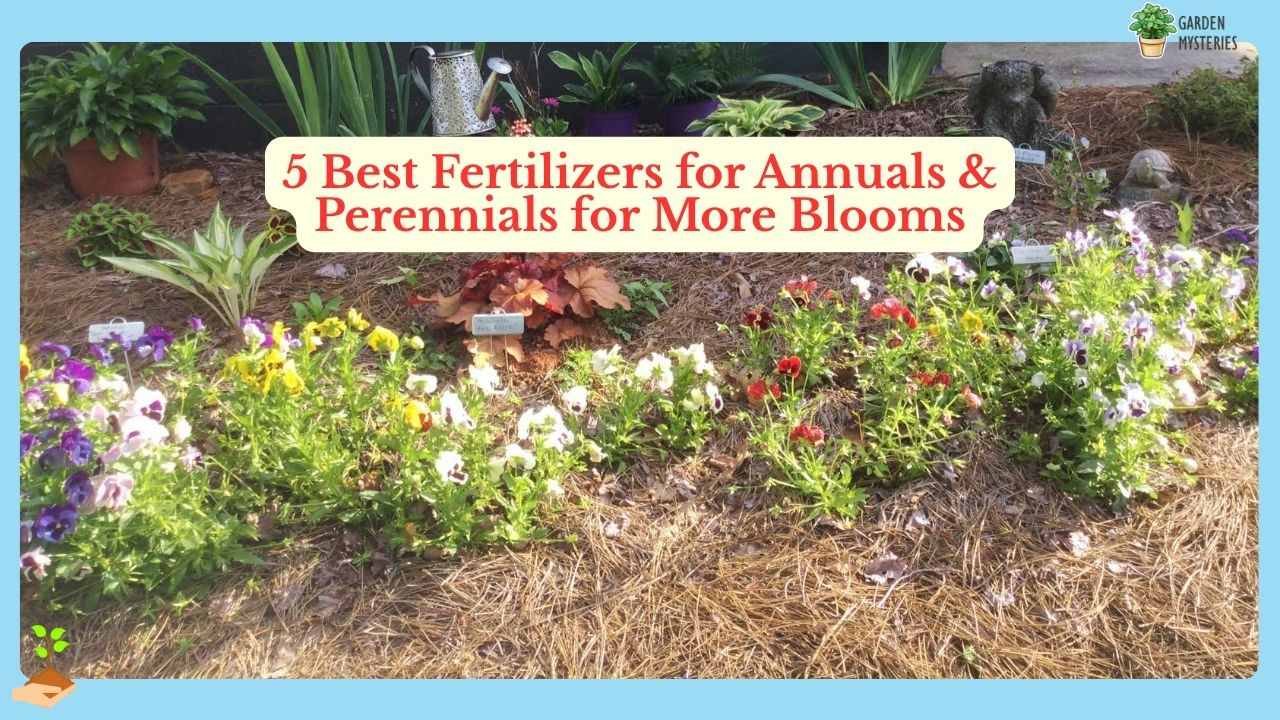
Best Fertilizers for Spring Vegetable Pairings
Healthy Spring vegetable pairings still need good nutrition. Soil is the stage, and fertilizer is the script.
Using 16-16-8 Liquid Fertilizer
A balanced 16-16-8 liquid fertilizer may provide:
- Nitrogen for leafy growth
- Phosphorus for roots
- Potassium for overall strength
Best used early in the season to support fast-growing spring vegetables.
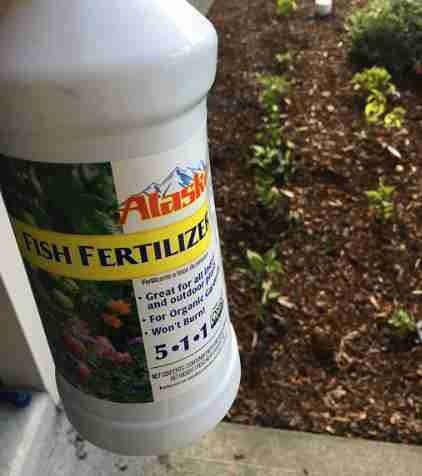
Best Fish Emulsion for Organic Spring Vegetable Pairings Garden
Fish emulsion is a gentle and organic option that:
- Feeds soil microbes
- Improves plant resilience
- Works well with leafy greens and tomatoes
It pairs beautifully with companion planting because it supports the entire soil ecosystem.
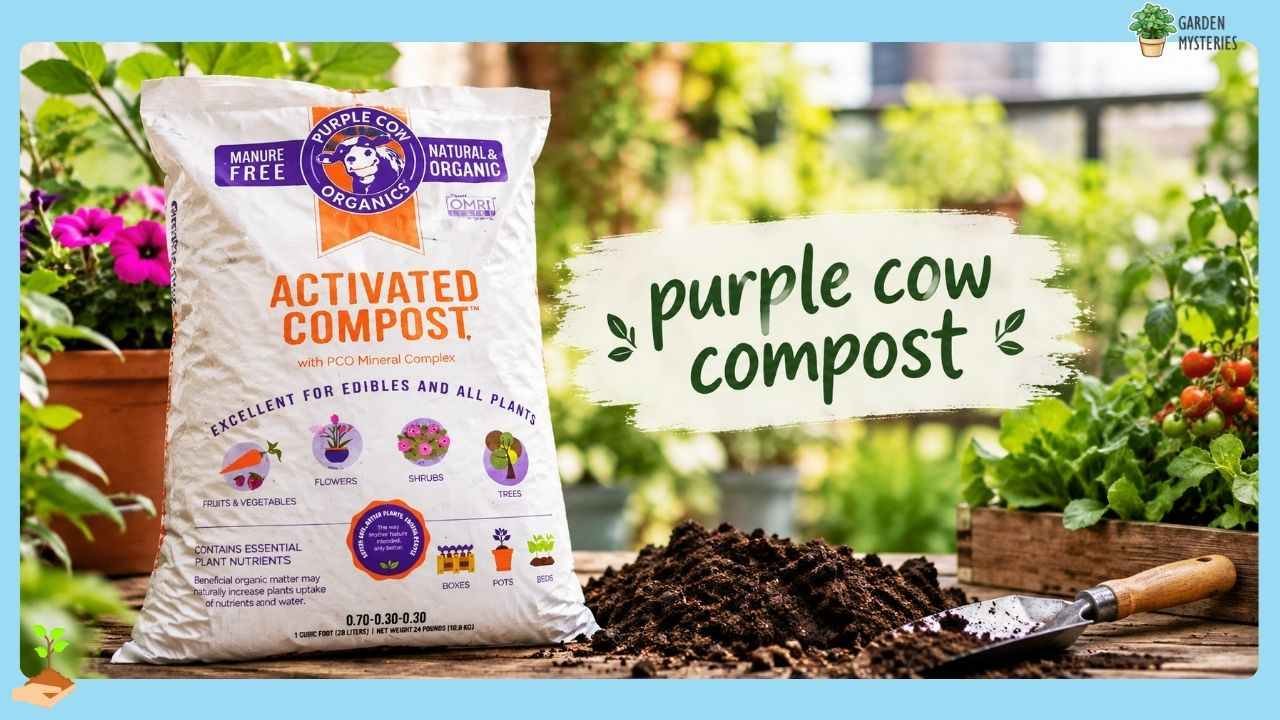
Is Black Kow Good for Vegetable Gardens?
Composted manure like Black Kow improves:
- Soil structure
- Moisture retention
- Microbial life
It’s especially useful when preparing beds before planting spring crops.
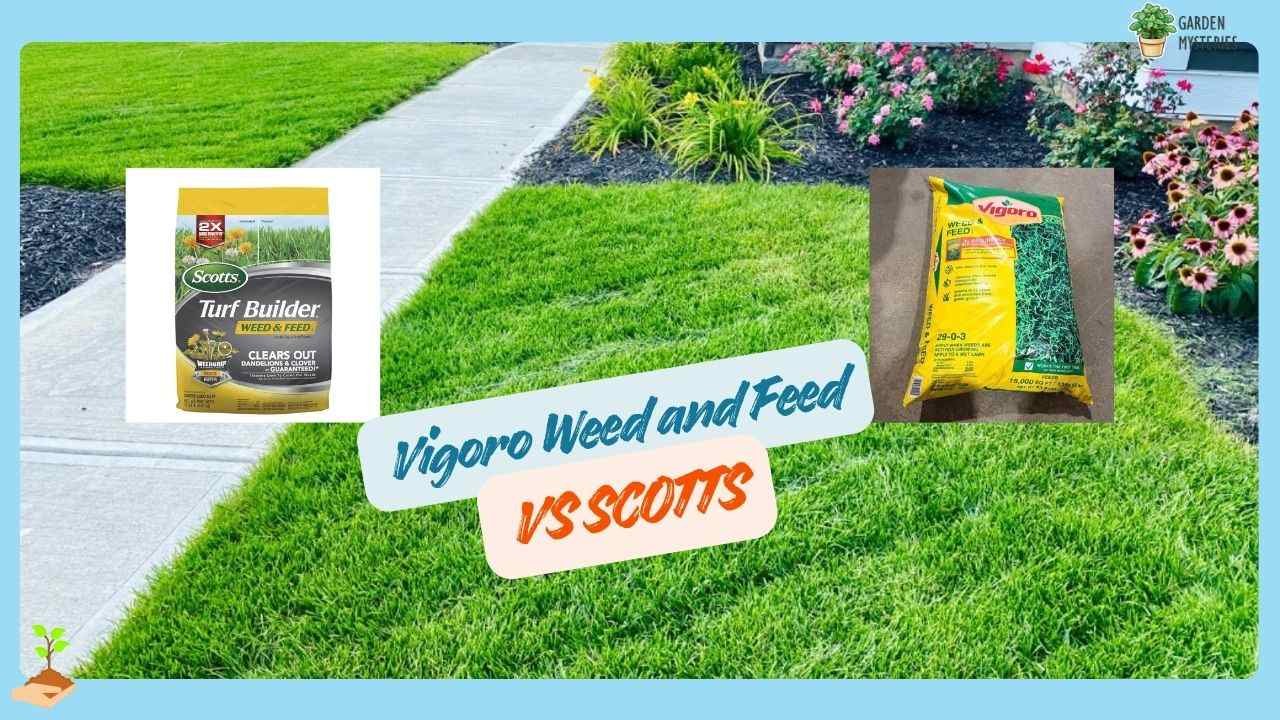
Sta-Green vs Miracle Gro Fertilizer
When choosing between Sta-Green and Miracle-Gro:
- Sta-Green → more budget-friendly, steady feeding
- Miracle-Gro → faster results, more concentrated
For vegetables, both can work, but organic options tend to support long-term soil health better.
Companion Planting for Small Gardens & Raised Beds
Limited space isn’t a limitation. It’s a puzzle with fewer pieces and sharper edges. With smart spring vegetable pairings, even a compact bed can behave like a full, thriving system.
Whether you’re working with containers or raised beds, companion planting vegetables lets you stack growth, timing, and function into the same square foot.
How to Make the Most of Small Spaces
In tight gardens, every plant needs a role. The goal isn’t just to grow more; it’s to grow smarter.
- Pair vertical plants with ground cover: Tall crops like tomatoes, corn, or peppers rise upward, leaving room below. Fill that space with low growers like lettuce or spinach to protect the soil and reduce weeds.
- Use fast-growing crops between slow ones: Radishes, lettuce, and greens mature quickly. Plant them between slower crops like cabbage or peppers. By the time the larger plants spread out, the quick crops are already harvested.
- Maximize sunlight with layered planting: Think in levels. Sun-loving plants go on top, shade-tolerant ones below. This creates a natural canopy that reduces water loss and keeps soil cooler.
Best Companion Pairings for Raised Beds
These combinations are especially effective in small layouts:
- Tomatoes + Basil or Lettuce → vertical + low-growing balance
- Carrots + Onions → shared space, pest protection
- Peppers + Cilantro → shade + pest control
- Cucumbers + Dill → climbing + pollinator support
These aren’t just the best companion plants for vegetables; they’re space-saving strategies.
Raised Bed Layout Tips for Beginners
If you’re new to raised bed companion planting, keep your layout simple:
- Plant taller crops at the back or center
- Leave airflow space to prevent plant disease’
- Avoid overcrowding, even if it’s tempting
- Rotate crops each season to maintain soil health
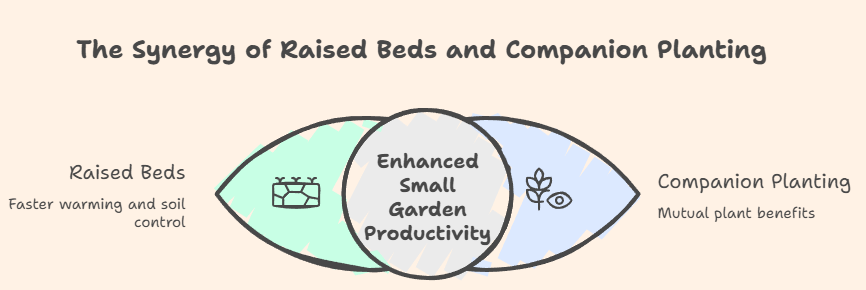
Raised beds warm up faster in spring, making them perfect for early spring vegetable pairings.
Why Companion Planting Works Better in Small Gardens
In smaller spaces, plant interactions are stronger and more immediate:
- Scents travel faster → better pest confusion
- Beneficial insects stay concentrated
- Soil moisture is easier to manage
It makes companion planting even more effective than in large, spread-out gardens.
Beginner Tips for Companion Planting Success
Starting with spring vegetable pairings doesn’t require a perfect plan. It requires observation, patience, and a willingness to let the garden teach you season by season.
If you’re new to companion planting vegetables, think of this as learning a language, simple phrases first, then full conversations.
Start with 2-3 Simple Spring Vegetable Pairings
Don’t try to plant everything at once. Begin with a few proven combinations like:
- tomatoes + marigolds
- carrots + onions
- peppers + cilantro
These are some of the best companion plants for vegetables, and they’re forgiving for beginners. It can help you clearly see what works without confusion.
Don’t Overcrowd Your Plants
It’s tempting to squeeze more into a small space, especially in raised beds. But overcrowding result in:
- Poor airflow
- Increased plant-disease risk
- Weaker growth
Even the best vegetable garden pairings fail if plants compete too closely for light and nutrients.
You should follow spacing guidelines, then layer intelligently instead of cramming.
Observe How Plants Respond
Companion planting isn’t fixed; it mostly changes with:
- Climate
- Soil type
- Seasonal pests
Watch for signs:
- Healthy leaves and steady growth → pairing works
- Yellowing, stunted growth → adjust spacing or partners
This step is what turns beginners into confident growers.
Improve Soil Before Adding Complexity
Healthy soil makes every pairing stronger.
Before experimenting with advanced companion planting for beginners, focus on:
- Adding compost (like aged manure or organic matter)
- Improving drainage
- Feeding soil microbes
Good soil supports root health, which is the foundation of every successful pairing.
Keep It Simple & Build Gradually
You don’t need a perfect vegetable companion planting chart memorized on day one. You should start small. Learn what shines in your space. Try to add more combinations each season. Because in the end, a garden doesn’t reward shortcuts; it rewards consistency.
FAQs
What vegetables grow well together?
Tomatoes, beans, peppers, and cabbage all benefit from companion planting with herbs and flowers like marigolds and thyme.
Does companion planting really work?
Yes, especially for pest control and space efficiency, though results vary by environment.
What is the best fertilizer for vegetable gardens?
The best fertilizers for vegetable gardens are balanced fertilizers, compost, and organic options like fish emulsion.
Can beginners use companion planting?
Absolutely, beginners can use companion planting. Start with simple pairings like tomatoes and marigolds.
Final Thoughts: Build a Smarter Spring Garden
A productive garden isn’t just about what you plant, it’s about who you plant together. With the right spring vegetable pairings, supported by healthy soil and smart feeding, your garden becomes more than productive. It becomes balanced and fruitful.
You should start small. Try to observe closely. Let the garden teach you the rest.
Note: This content follows Google policies by focusing on helpful, user-first information. It is structured for natural readability, real gardening intent, and E-E-A-T (experience, expertise, authority, trust).