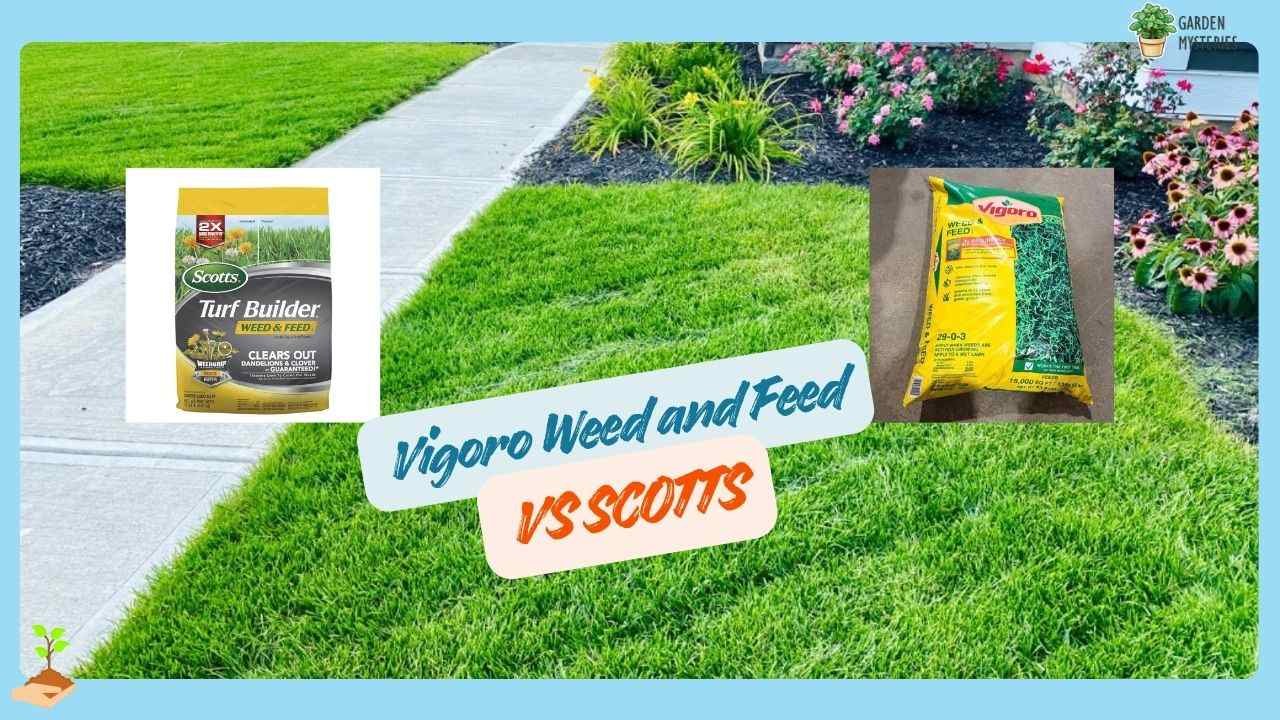
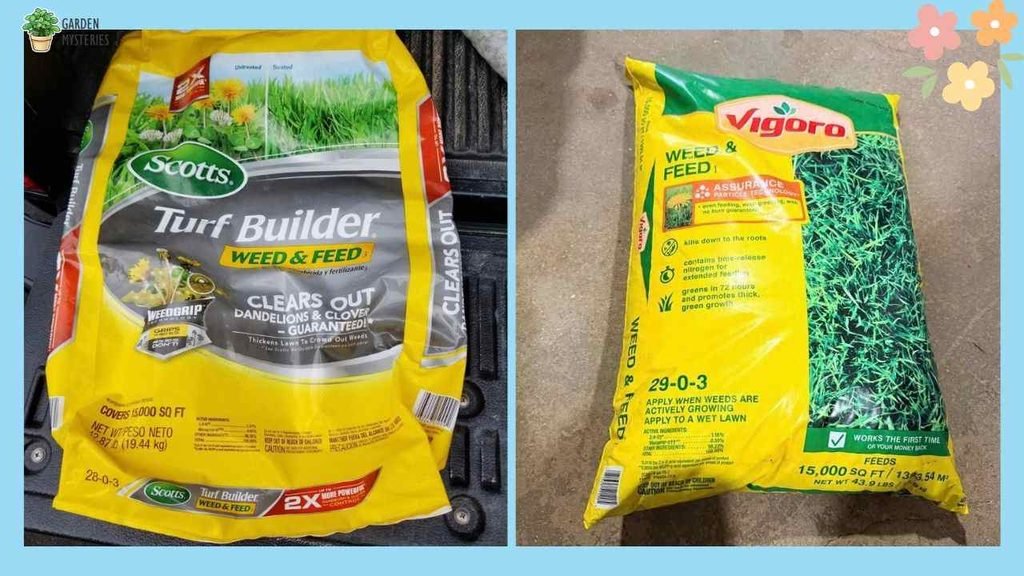
Vigoro weed and feed vs Scotts comes down to the exact product, not just the brand name. Both brands sell lawn products that combine fertilizer with weed control, but their formulas, coverage, application instructions, and target weeds can differ.
The confusion starts because Vigoro and Scotts each have several lawn-care products. Even Vigoro currently lists different Weed and Feed products, including 29-0-3 formulations with different bag sizes and stated treatment periods.
I would compare the label before comparing the logo on the bag. In this guide, I’ll look at the fertilizer analysis, weed control, application process, lawn compatibility, value, and common mistakes so you can make a more informed choice.
Key Takeaways
- Compare exact formulas rather than comparing only the two brands.
- Vigoro currently lists 29-0-3 Weed and Feed products.
- Scotts Weed and Feed formulas can contain 2,4-D and dicamba.
- Lawn type and target weeds matter before choosing either product.
- Spreader settings and application conditions can affect your results.
- Check coverage and label instructions before comparing prices.
Note: This article may contain Amazon and other affiliate links. We may earn a commission from qualifying purchases. Information is for general purposes only. Always follow product labels and manufacturer instructions.
What Is the Difference Between Vigoro and Scotts Weed and Feed?
Weed and feed is a lawn product that combines fertilizer with weed control in one application. The idea is straightforward: provide nutrients to the grass while controlling certain listed weeds.
Current Home Depot listings show Vigoro Weed and Feed products with a 29-0-3 fertilizer analysis. The listings include a 33.6-pound 12-month product and an 11.2-pound 4-month product, so even the Vigoro range should not be treated as one identical formula.
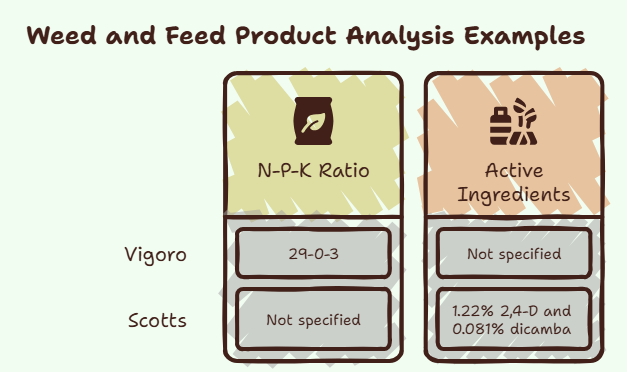
Scotts also sells several Weed and Feed products under the Turf Builder range. One current EPA registration for a Scotts Turf Builder Weed & Feed formulation lists 2,4-D and dicamba as active ingredients. The registered label also identifies several compatible turf types, including bluegrass, fescue, ryegrass, Bermuda, and zoysia.
That is why the vigoro weed and feed comparison needs to start with the exact bag. A 29-0-3 label tells you the fertilizer analysis, but it does not tell you everything about the weed-control ingredients or application requirements.
The term feed and weed can sound like a single category, but products within that category can behave differently. I would check the N-P-K numbers, active ingredients, target weeds, grass types, coverage, and application directions before buying.
How Do the Formulas and Weed Control Compare?
The formulas differ because fertilizer analysis and weed-control ingredients are separate parts of a Weed and Feed product.
The first number in an N-P-K ratio represents nitrogen, the second represents phosphate, and the third represents potash. A 29-0-3 product therefore provides a substantial nitrogen component while showing zero phosphate and three percent potash by weight.
Vigoro’s current Home Depot listings show 29-0-3 products. However, I would avoid writing that every Vigoro Weed and Feed product has exactly the same analysis because product ranges can change.
Scotts provides another useful example of why checking the exact product matters. The EPA registration for one Turf Builder Weed & Feed formulation lists 1.22% 2,4-D and 0.081% dicamba as active ingredients. The same registration lists several broadleaf weeds and compatible lawn grasses.
This is where scotts weed and feed should be judged by its label rather than by general brand reputation. The weed list matters because a product may be designed for certain weeds but not others.
I also would not treat the presence of the same active ingredient as proof that two products will perform identically. Concentration, formulation, granules, application rate, lawn conditions, and timing can all affect the practical result.
How Should You Apply Weed and Feed?
Applying Weed and Feed correctly means following the exact product label, using the right amount, and applying it under suitable lawn conditions.
Check the Lawn First
Before learning how to apply vigoro weed and feed, identify the grass and weeds in your lawn. This small step can prevent a lot of guesswork.
Check whether the product lists your grass type and target weeds. The current EPA record for one Scotts formulation, for example, includes several turf types and a long list of listed weeds.
Measure the lawn area as well. A bag that looks inexpensive can provide less value if its coverage is much lower than another product.
Calibrate Your Spreader
The correct spreader setting matters because too little product may not provide the intended treatment, while excess application can create lawn problems.
Before applying how to use vigoro weed and feed, read the bag instructions and set the spreader accordingly. Walk at a steady pace and avoid heavy overlap between passes.
Pay Attention to Conditions
Application timing also matters. Scotts’ current product information says its Turf Builder Weed & Feed₅ should be applied when weeds are actively growing, with daytime temperatures between 60 and 90°F. It also instructs users to apply it when the grass is wet so the particles can adhere to weed leaves.
That does not mean every Weed and Feed product has identical instructions. Treat the label on your own bag as the final reference.
Which Product Fits Different Lawn Situations?
Neither product can be judged properly without knowing the lawn, weeds, and exact formulation being compared.
If Price Matters: Vigoro Weed and Feed vs Scotts
Compare the total price against the coverage rather than looking only at the sticker price.
For example, current Home Depot listings show Vigoro 29-0-3 products in different bag sizes and treatment periods. The listed prices can also change, and Home Depot notes that local store prices may vary.
A useful calculation is:
Product price ÷ total square-foot coverage = cost per square foot
That gives you a more meaningful comparison.
If Weed Control Matters
Look at the weeds named on the label. The current EPA registration for one Scotts formulation lists weeds such as dandelion, chickweed, plantain, and several other broadleaf weeds.
Do not assume that every weed in your lawn will respond in the same way. Also, there is another nice alternative to Vigoro Weed & Feed from amazon its called BioAdvanced 5-in-1 Weed and Feed Granules. Check that out too in your free time.
If You Are Treating the Lawn in Fall
A product such as vigoro fall weed and feed should be considered according to its exact label and intended season. Fall application can have different timing requirements than spring treatment.
The same rule applies to scotts lawn turf builder products. Scotts sells several Turf Builder products, and their purposes are not identical. Always match the specific product with the job you want it to perform.
What Mistakes Can Make Weed and Feed Less Effective?
Most Weed and Feed problems start with incorrect product selection or application rather than the brand name itself.
Avoid These Common Mistakes
Before using any Scotts or Vigoro fertilizer weed and feed, check these points:
- Applying without identifying the grass type
- Choosing a product that does not list your target weeds
- Guessing the spreader setting
- Applying more than the label rate
- Ignoring temperature requirements
- Applying at the wrong stage of weed growth
- Overlapping spreader passes
- Allowing granules to reach nearby garden plants
- Comparing bags without checking coverage
- Assuming every product from one brand has the same formula
The EPA label for the Scotts Turf Builder Weed & Feed formulation includes specific directions and restrictions involving application conditions, turf types, and weeds.
This is also where my broader gardening experience influences how I approach product comparisons. When I use garden products, I prefer to follow the label first and then observe what happens rather than assume a product will behave exactly as advertising suggests. I would use the same approach with lawn fertilizer.
For example, my own balcony gardening experience with perlite has taught me to pay attention to how a product actually behaves in a growing setup. I used Back to the Roots 100% Organic Perlite during May and June, and later noticed blooming plants and harvested lemons. I consider that a personal observation, not proof that the perlite caused those results. The same standard should apply here.
Vigoro Weed and Feed vs Scotts: What Should You Check Before Buying?
The most useful comparison is the exact product label, including its fertilizer analysis, weed-control ingredients, coverage, grass compatibility, and application instructions.
| What to compare | Why it matters |
| N-P-K ratio | Shows the fertilizer analysis |
| Active ingredients | Identifies the weed-control ingredients |
| Listed weeds | Shows the weeds the product targets |
| Grass compatibility | Helps avoid unsuitable applications |
| Coverage | Shows how much lawn one bag treats |
| Spreader settings | Helps with even application |
| Application conditions | Affects when the product should be used |
| Price per square foot | Makes value comparisons more useful |
This approach is more reliable than simply asking which brand is better.
It also helps separate lawn products from other garden materials. For example, Compost vs Potting Soil is a different comparison because those materials serve different growing purposes. A raised bed soil mix is also designed for garden beds rather than routine lawn feeding.
Likewise, Sta-Green vs Miracle-Gro involves another product comparison, while Scotts vs Vigoro Mulch belongs to a different category altogether. Those products should be compared using criteria suited to their specific jobs.
FAQs: Vigoro Weed and Feed vs Scotts
The price depends on the exact product, bag size, coverage, and current retailer pricing. Vigoro currently has different 29-0-3 products with different sizes, so comparing price per treated square foot is more useful than comparing bag prices alone.
No single Weed and Feed product should be assumed to suit every grass type. Check the exact label before application. Grass compatibility can vary between formulations.
The timing can vary with the product, weed species, weather, lawn conditions, and application method. Avoid treating a manufacturer’s stated timing as a guarantee for every lawn.
Follow the exact product instructions. Some products have specific moisture requirements during application. For example, Scotts’ current Turf Builder Weed & Feed₅ instructions call for application when the grass is wet.
Some products are specifically marketed for seasonal use, but the correct timing depends on the exact formulation and lawn type. Check the product label before applying it in fall.
Conclusion
Vigoro weed and feed vs scotts is not really a simple brand-versus-brand question. The better comparison starts with the exact bag, then moves through fertilizer analysis, active ingredients, listed weeds, grass compatibility, coverage, price, and application instructions.
Current Vigoro listings show 29-0-3 Weed and Feed products, while an EPA-registered Scotts Turf Builder Weed & Feed formulation lists 2,4-D and dicamba among its active ingredients.
I would always check the label before making a purchase or spreading the granules. A few minutes spent comparing the details can tell you much more than the brand name printed across the front of the bag.
Disclaimer: This post may contain Amazon affiliate links, which may earn us a commission. Ads may also appear through Google AdSense. These do not affect our editorial opinions.
More Reads: