Most plant products come with a label that tells you almost nothing useful. “Apply as needed” or “use regularly” sounds helpful, but it leaves you guessing every single time you water. Here with MitoGrow Pots and Planters, you will have a workable guideline to follow.
That guessing game is exactly why so many potted plants stay stuck. Too little product and nothing changes. Too much and you feel like you wasted money on something that did not work.
Getting the MitoGrow pots and planters dosage right is simpler than the label makes it seem. This blog will break it down by situation, pot size, and plant condition so you always know exactly what to do.
What Is MitoGrow Pots and Planters?
MitoGrow Pots and Planters is a patented biostimulant powder made specifically for potted and container plants. It is not a fertilizer, not even a potting soil or compost. It works at the cellular level to improve nutrient uptake for indoor plants by helping roots absorb what is already in your soil more efficiently.
Think of it as a performance booster for your plant’s root system. You are not adding more food; you are helping the plant actually use the food it already has access to.
What Is Inside the Formula?
The formula combines Indole-3-Butyric Acid (IBA), Vitamins B1, B3, and B6, Cytokinin, Bacillus amyloliquefaciens, and a blend of mycorrhizal fungi spores. Each ingredient plays a specific role in plant root health and stress recovery.
- IBA: Stimulates new root growth at the cellular level.
- Vitamin B1, B3, B6: Help the plant handle stress and bounce back faster.
- Bacillus amyloliquefaciens: A beneficial bacterium that supports nutrient availability in the root zone.
- Mycorrhizal fungi spores: Expand the root surface area so the plant can pull in more water and nutrients.
This specific formula is very suitable to mix with raised bed soil for vegetables.
What Does “Dosage” Actually Mean for a Biostimulant?
Unlike a fertilizer, MitoGrow does not carry an overdose risk for your plants. But using the wrong amount still matters. Too little and the active ingredients never reach effective concentration. Too much and you are simply burning through your bag faster than needed.
Biostimulant dosage is really about two things: correct dilution and consistent application. Get those two right, and the product does exactly what it promises.
How Much MitoGrow to Use Per Gallon
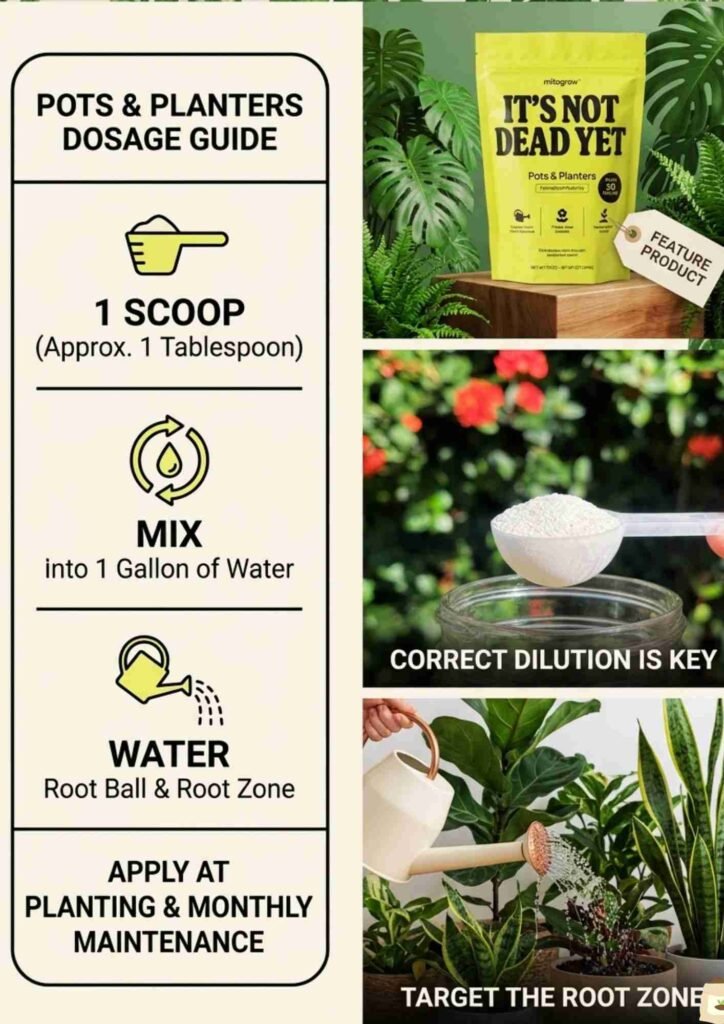
Use 1 to 2 tablespoons of MitoGrow per gallon of water. One tablespoon works well for regular maintenance watering. Two tablespoons is the right amount when planting, transplanting, or reviving a stressed plant.
The included scoop equals approximately 1 tablespoon, and one bag makes up to 50 gallons of solution. Keeping track of how much Mitogrow to use per gallon from the start means your bag lasts longer and your results stay consistent.
MitoGrow vs Regular Fertilizer: What Is the Difference?
Fertilizers add nutrients directly to your soil. MitoGrow helps your plant actually absorb the nutrients already sitting there. They solve two different problems, and using both together gives you better results than either one alone. Nearly every MitoGrow pot and planters review from real buyers mentions this pairing as the approach that works best.
Think of fertilizer as the meal, and MitoGrow as the digestive system that makes sure the meal gets used properly. One without the other leaves something on the table.
So, never be confused thinking MitoGrow as a liquid fertilizer or a granular fertilizer.
Which One Should You Use First?
Start with MitoGrow at the moment of transplanting or new planting. Hold off on fertilizer until the plant has settled in and shows signs of new growth.
Applying MitoGrow first reduces transplant shock and builds a stronger root system. That root system then absorbs your fertilizer far more efficiently when you do add it, so you get more out of every feeding. Don’t forget to read our blog on mulch attracts cockroaches in your free time.
MitoGrow Pots and Planters Dosage at a Glance
The mitogrow pots & planters dosage by pot size is not actually based on pot size directly. It is based on how much water you use per watering. The ratio stays fixed at 1 to 2 tablespoons per gallon, no matter the container.
| Pot Size | Water per Watering | MitoGrow Amount | Use Case |
| Small (4 to 6 inches) | 0.25 to 0.5 gallon | 0.25 to 1 tbsp | Maintenance or new planting |
| Medium (8 to 10 inch) | 0.5 to 1 gallon | 0.5 to 2 tbsp | Maintenance or transplant recovery |
| Large (12 to 14 inch) | 1 to 2 gallons | 1 to 4 tbsp | Transplanting or stress recovery |
| Planter Box | 1 to 3 gallons | 1 to 6 tbsp | Seasonal planting or refresh |
| Large Outdoor Container | 2 to 4 gallons | 2 to 8 tbsp | Establishment or revival |
MitoGrow Pots and Planters Dosage in Detail: Situation by Situation
Knowing mitogrow pots planters how to use it correctly starts with identifying your situation. The mitogrow pots and planters dosage itself stays the same, but the frequency and timing shifts depending on what your plant is going through right now.
New Planting or Transplanting
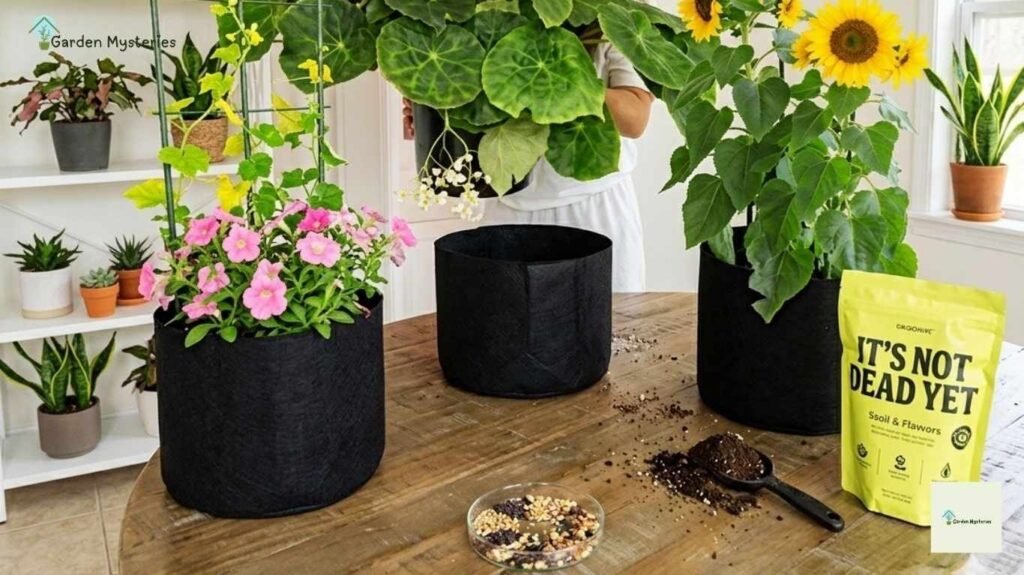
Transplant shock happens because moving a plant tears fine root hairs, cutting off the plant’s ability to absorb water and nutrients. Applying MitoGrow immediately at planting gives those roots the best chance to rebuild fast.
- Apply 2 tablespoons per gallon on day one, right at the root zone
- Repeat with the same dose after 7 days to support continued root development
- Drop to 1 tablespoon per gallon monthly after that for ongoing support
- Skip fertilizer for the first two weeks and let MitoGrow do the early work
Maintenance Watering for Healthy Plants
This is the most common mitogrow pots planters how to use scenario. Your plant is doing fine, and you just want to keep it that way. Use 1 tablespoon per gallon every 2 to 4 weeks alongside your normal watering routine.
- Mix into your watering can before every second or third watering
- Pair with your regular fertilizer for stronger overall results
- No need to change your watering schedule or volume
Reviving a Struggling or Stressed Plant
When a plant looks like it is giving up, the root system is usually the real problem. Stress from heat, overwatering, drought, or neglect damages roots first, and that is exactly where MitoGrow focuses.
- Use 2 tablespoons per gallon every 5 to 7 days for the first 2 to 3 weeks
- Apply directly to the root zone, not as a foliar spray
- Most users report visible improvement within 1 to 4 weeks
- Once you see recovery, reduce to the standard maintenance dose
When to Use MitoGrow and When to Skip It
MitoGrow works best when a plant is under stress, being moved, newly planted, or coming out of a rough season. Plants already growing in ideal conditions with perfect soil and consistent feeding will show subtler changes. That is when MitoGrow pots & planters results are most dramatic and most worth the investment.
Best Times to Apply MitoGrow Pots & Planters
The highest-impact moments are all tied to root disruption or environmental stress. If your plant’s root system is working harder than usual, MitoGrow gives it meaningful support right when it needs it most.
- At transplanting, before the plant shows any signs of shock
- After repotting into fresh soil, even if the plant looks fine
- In early spring, when plants wake up and push new root growth
- After extreme heat, cold snaps, or drought stress
- When bringing a new plant home from a store or nursery
You can also mix it with topsoil for gardening, especially when you plant new plants.
When It Might Not Be Necessary
If your plant is actively thriving, your soil is healthy, and you fertilize on a consistent schedule, the visible difference from MitoGrow will be smaller. It will not hurt the plant in any way, but the payoff is less dramatic when conditions are already close to perfect.
Common Mistakes People Make With MitoGrow Dosage
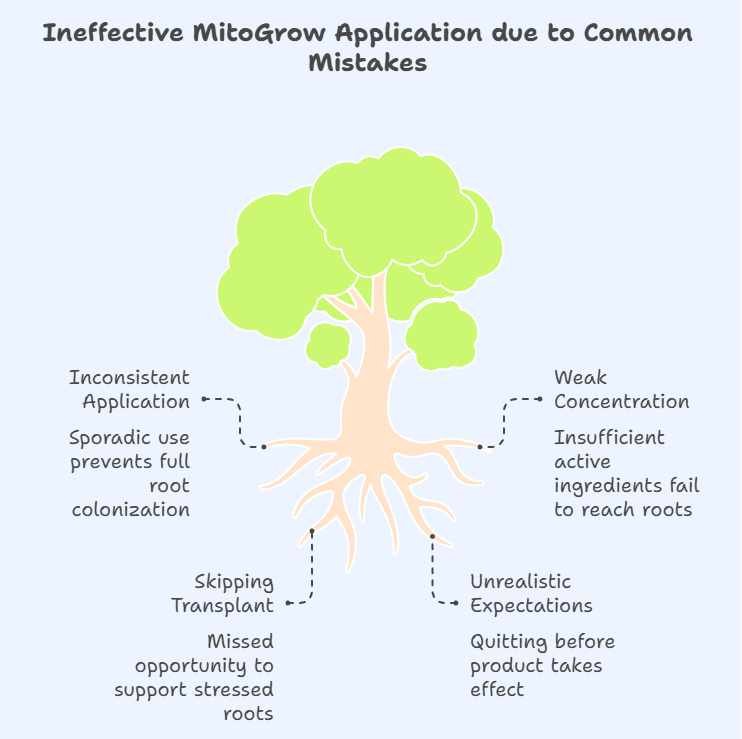
The most common mistake is treating MitoGrow like a fertilizer, either dumping in extra hoping for faster results, or abandoning it after one application because nothing changed overnight. Most dosage problems come from inconsistency, not from the amount itself.
Using It Only Once
Mycorrhizal fungi need repeated exposure to fully colonize a root system. One application starts the process but does not finish it. Consistent use over several weeks is what actually builds the long-term root network that makes the difference.
Mixing It Too Weak
Dropping below 1 tablespoon per gallon means the active ingredients never reach an effective concentration at the root zone. For stressed plants, especially a weak mix is close to no mix at all.
Skipping It at Transplant Time
Transplanting is the single highest-impact moment to apply MitoGrow. The roots are disrupted, the plant is vulnerable, and this is exactly when the formula does its best work. Skipping it here wastes the biggest opportunity.
Expecting Overnight Results
Root colonization and cellular repair take time. Most users see visible improvement within 1 to 4 weeks, depending on plant condition. If you stop after a few days because nothing looks different, you are quitting right before the product kicks in.
Does MitoGrow Really Work? What Real Users Report
Based on Mitogrow pots and planters review feedback from hundreds of verified buyers, most users see visible improvement within 1 to 4 weeks. Results are strongest on transplanted plants and those recovering from stress, neglect, or difficult growing conditions.
The pattern is consistent across different plant types and climates. People who follow the dosage correctly and apply at the right moments get the most out of it.
What Users Say About Results
The most repeated finding across mitogrow pots and planters review posts is faster root establishment and noticeably stronger leaf color within the first few weeks of consistent use.
- New growth appearing on plants that seemed completely finished
- Faster, stronger establishment after repotting into fresh soil
- Richer, deeper leaf color on plants growing in lower light
- Significantly reduced transplant shock after moving or dividing plants
Plants already growing in healthy conditions with good soil and regular feeding will see subtler changes. MitoGrow is a booster for struggling or transitioning plants, not a treatment for root rot or disease. Also, they come with an outdoor version mix called Tree & Shrub. Feel free to check that out too.
FAQs: MitoGrow pots and planters
You cannot harm your plant by using slightly more than recommended. However, exceeding the suggested dose does not improve results and burns through your bag faster than necessary. Stick to the 1 to 2 tablespoon per gallon range.
For healthy plants, apply every 2 to 4 weeks during regular watering. For stressed or newly transplanted plants, apply every 5 to 7 days for the first two to three weeks, then drop to monthly maintenance.
Yes, and MitoGrow actually recommends it. The biostimulant helps your plant absorb nutrients more efficiently, so combining it with liquid fertilizer in the same watering can gives you stronger results from both products.
Most users notice visible improvement within 1 to 4 weeks. Transplanted or severely stressed plants tend to respond faster. Plants in stable, healthy conditions may show more gradual changes over several weeks of consistent use.
Yes. MitoGrow Pots & Planters works across a wide range of indoor and container plants, including tropical houseplants, succulents, herbs, and flowering plants. Follow the standard dosage, and it is safe for regular use on any potted plant.
End Note
Getting the mitogrow pots and planters dosage right is not complicated once you know the formula. One to two tablespoons per gallon, applied at the right moment, and repeated consistently, is all it takes to see real results.
Start at transplant time if you want the strongest possible outcome. Give it 1 to 4 weeks to work through the root system, and you will likely wonder why you waited so long to try it.
Note: Gardening results may vary based on climate, soil, plant type, and fertilizer use. Always follow product labels and test amendments carefully before applying them widely in your garden.