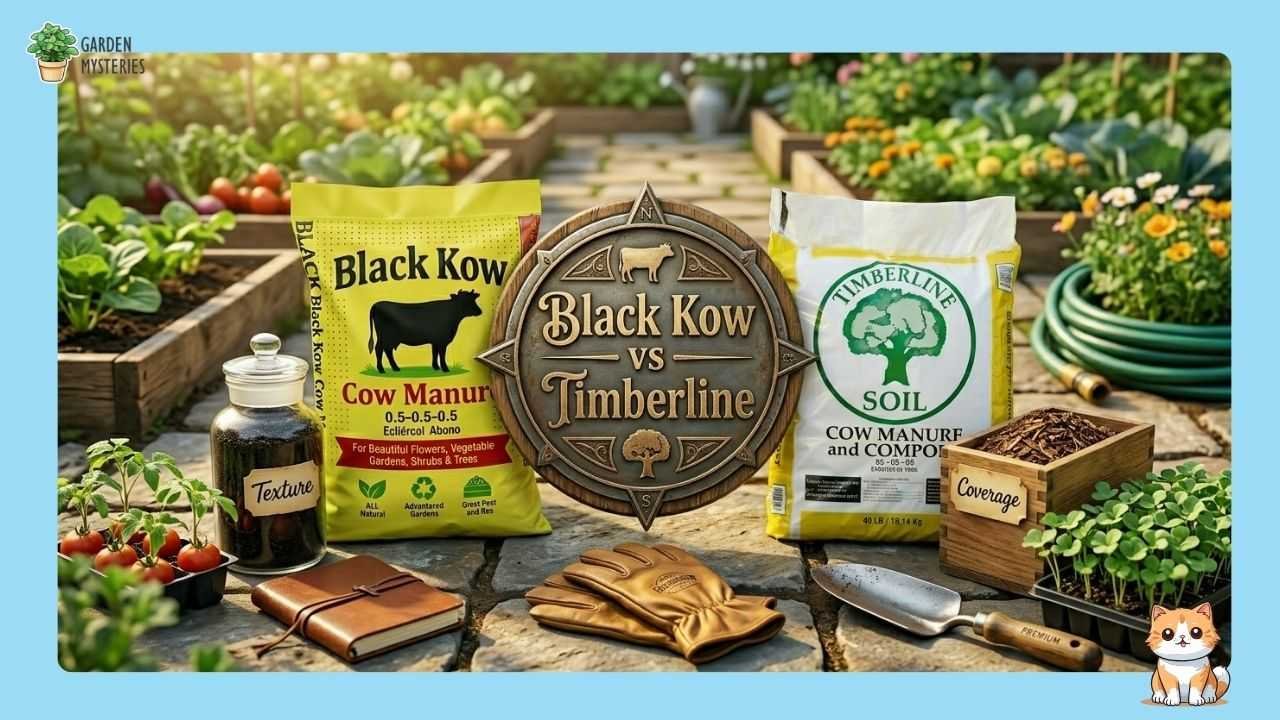
In Timberline vs Black Kow, Black Kow wins on texture, manure content, and ease of use, while Timberline wins on price and coverage area for large gardens. Both are composted cow manure products, but they are built for different gardening budgets and goals.
The confusion between these two brands is real. Both sit on the same store shelf, both say “cow manure compost” on the bag, and both look similar at first glance. But the price gap is significant, and that naturally makes gardeners wonder what they are actually paying for.
I have used both brands across different seasons, and the difference showed up clearly once I started paying attention. If you want to stop guessing and pick the right brand for your garden, this breakdown covers everything you need to know.
Key Takeaways: Black Kow vs Timberline
- Black Kow has finer texture and higher manure content per bag
- Timberline costs far less and works well for large soil areas
- Black Kow vs Timberline price gap is roughly $27 per cubic foot
- Black Kow suits raised beds and seed starting better overall
- Timberline is the practical pick when budget is the main concern
What Is Black Kow Compost?
Black Kow is a composted cow manure product made by Black Kow Company, specifically designed to improve soil structure, add organic matter, and feed garden plants over time.
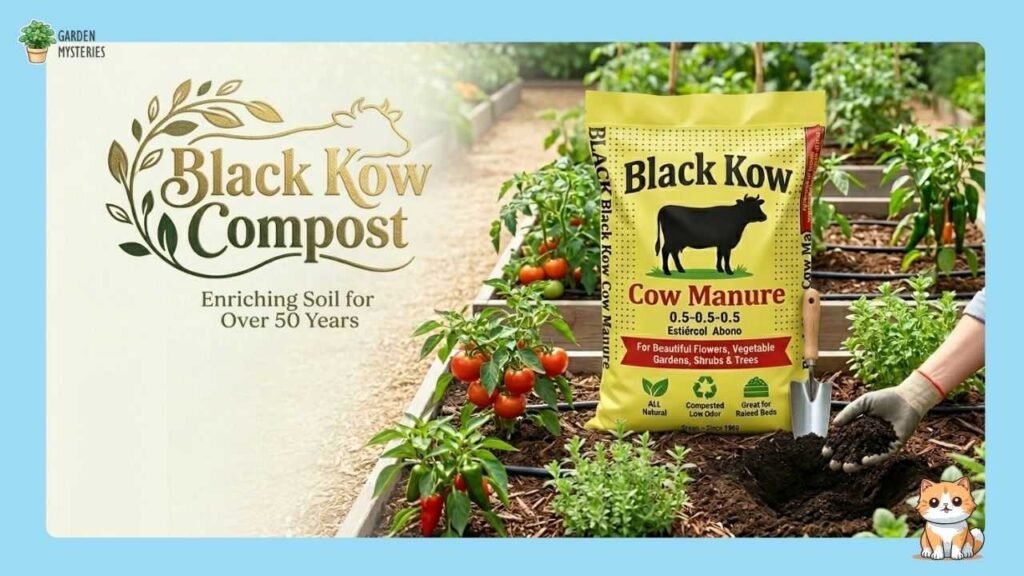
It is one of the most recognized cow manure brands in the US, sold at Home Depot, Lowe’s, Walmart, and Target. The brand positions itself as a premium organic soil amendment. It carries a 0.5-0.5-0.5 NPK ratio, feeds plants for up to three months, and is fully aerobically composted to reduce odor.
This is a best cow manure compost for tomatoes, peppers, and herbs. It is darker, denser, and generally more manure-rich than most budget compost alternatives. A 1 cu. ft. bag retails for around $29 to $32 depending on the store.
Key Features
- Composted cow manure with a fine, dark texture
- Screened for a more uniform consistency
- Fully aged organic matter with low odor
- Mixes easily into existing soil without clumping
- Suitable for vegetable gardens, raised beds, and containers
What Is Timberline Cow Manure Compost?
Timberline is a cow manure and compost blend made by Oldcastle, a large landscaping materials company. It is a Timberline compost quality product positioned as a budget-friendly soil conditioner for gardens, lawns, and large planting areas.
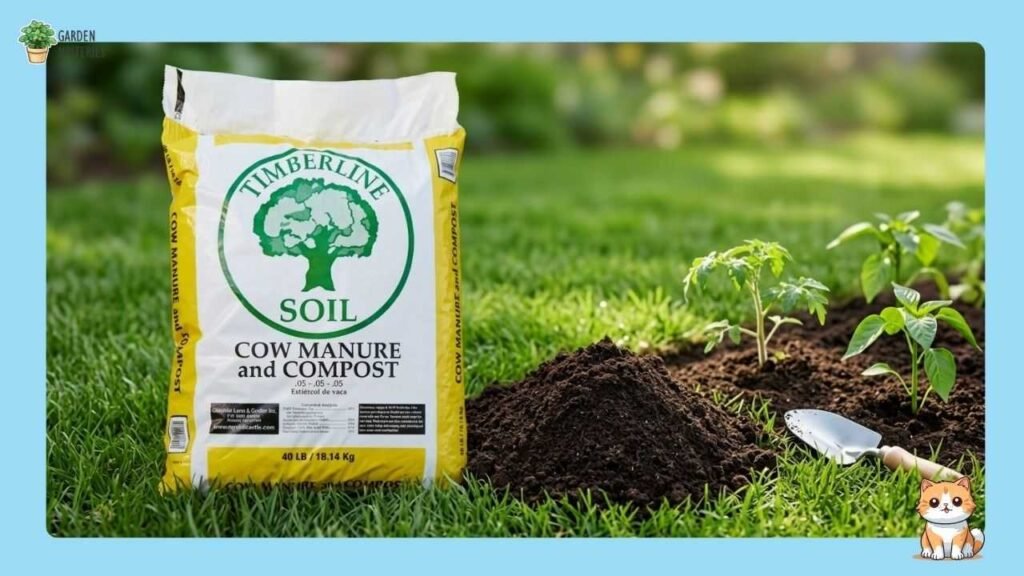
The 40 lb bag of Timberline Cow Manure typically sells for around $2.50 to $3.00 at Walmart and Lowe’s, making it one of the most affordable manure compost products on the market.
This is a solid workhorse product for gardeners who need to condition large stretches of soil without spending much. It is widely available across the US and gets respectable customer ratings despite the lower price point.
Key Features
- Composted manure blended with organic forestry material
- Coarser texture with occasional wood particles
- Budget-friendly at roughly $2.50 to $3.00 per 40 lb bag
- Good for large garden areas and general soil conditioning
- Suitable for lawns, flower beds, and seasonal bed preparation
Black Kow vs Timberline at a Glance
When comparing Black Kow vs Timberline compost side by side, the core differences come down to quality, price, and the type of gardening each brand is built for.
| Feature | Black Kow | Timberline |
| Overall Quality | Winner | Budget Option |
| Manure Content | Higher | Lower |
| Texture | Fine and Uniform | Coarser |
| Wood Debris | Minimal | More Common |
| Raised Beds | Excellent | Good |
| Seed Starting | Better Choice | Less Suitable |
| Soil Mixing | Easy | Moderate |
| Price (approx.) | $29 to $32 / cu. ft. | $2.50 to $3 / 40 lb |
| Best For | Premium Results | Budget Gardening |
Key Differences Between Black Kow and Timberline
Black Kow vs Timberline cow manure is really a comparison between two different brand philosophies: one prioritizes compost quality, the other prioritizes affordability and volume. The differences below show up in real garden use, not just on the label.
Price
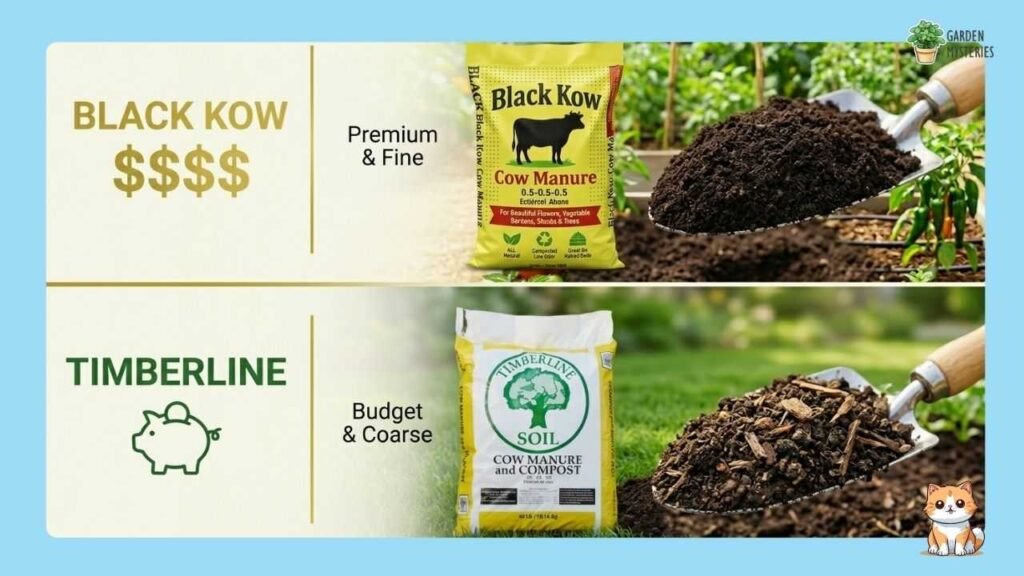
At roughly $29 to $32 per cubic foot, the cost of Black Kow is significantly higher than the other. It’s the most significant disadvantage of Black Kow.
A 40 lb Timberline bag runs about $2.50, which means you can buy ten or more Timberline bags for the price of one cubic foot of the premium option.
For small raised beds or container gardens, the higher price is often worth it. For large in-ground areas or seasonal soil conditioning across a full backyard, the budget brand makes far more practical sense.
Manure Content
Black Kow generally runs darker and denser, which suggests a higher ratio of actual composted manure to other organic filler. The result is a richer-looking product with fewer visible non-manure particles throughout the bag.
On the other hand, Timberline contains a larger amount of coarse organic filler from lumber and forestry by-products. This is not necessarily bad for the garden, but it does mean you are getting less manure per pound and more woody bulk material overall.
Texture
The premium brand, Black Kow, typically has a fine, crumbly consistency that breaks apart easily and distributes well through existing soil. Most gardeners describe it as dark, moist, and smooth with very few large chunks when you get a good batch.
The budget brand, Timerline, runs noticeably rougher. Some bags contain larger wood particles, occasional sticks, or uneven chunks. This makes it harder to use in fine seed-starting mixes and can require some screening before use in delicate setups.
Ease of Use
The finer product of Black Kow mixes into soil quickly without much effort. It spreads cleanly, does not compact in the bag, and is ready to use directly from the bag in most garden situations.
Consequently, Timberline works fine for general soil improvement but may need extra mixing or even screening before it goes into a raised bed soil for vegetables or fine growing medium. It is better suited for broad applications where texture uniformity matters less.
Moisture Retention
Many gardeners report noticeably improved moisture retention after using both products, likely due to its finer organic matter breaking down and integrating more completely into the soil. This is especially useful in sandy or fast-draining beds.
When comparing these two in the context of Black Kow vs Black Velvet or Black Kow vs Brut Cow compost, Black Kow tends to still come out ahead on texture. But against Timberline specifically, the winner depends on your goals, not just the product itself.
Which Compost Has More Manure?
Black Kow generally contains a higher proportion of composted cow manure and fewer visible wood fragments per bag. The darker color and finer texture are consistent with a higher manure-to-filler ratio compared to most budget alternatives.
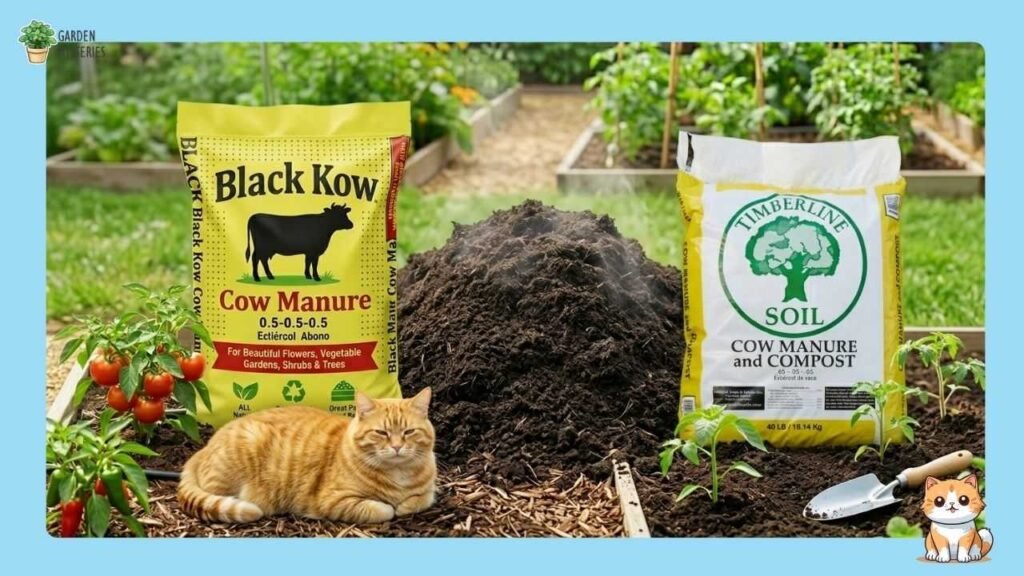
Timberline is made using by-products from farming and forestry industries. The blend includes cow manure, but also a fair amount of coarser organic material from lumber processing.
If pure manure content matters most for your garden goals, the price difference between Black Kow vs Timberline compost reflects a real formulation difference. The premium bag gives you more of what you are actually paying a cow manure product for.
Black Kow vs Timberline: Which Is Better for Raised Beds?
For raised beds, Black Kow is usually the better choice between the two brands. Its finer texture allows nutrients and organic matter to distribute more evenly throughout the growing medium, which matters a lot in the contained environment of a raised bed.
When I first started using manure compost in my raised beds, I made the mistake of grabbing whatever was cheapest. The coarser product left chunky spots that took a full season to break down.
Timberline can still work in raised beds, especially if you mix it thoroughly or screen out the larger particles first. For a raised bed soil mix for vegetables on a tighter budget, it is a reasonable compromise. It just takes a little more effort to work in properly.
Which Compost Is Better for Vegetable Gardens?
For vegetable gardens, Black Kow edges ahead because its finer texture and higher manure content integrate better with growing soil. Vegetables like tomatoes, peppers, and herbs respond well to the consistent nutrient release that comes from a well-composted, manure-rich product.
Black Kow is often preferred for:
- Tomatoes
- Peppers
- Cucumbers
- Squash
- Herbs

However, Timberline has real value for large vegetable plots where you need to condition a wide area before planting. Many gardeners use it as a base layer to break up clay or improve sandy ground, then add a finer amendment on top.
Timberline is commonly used for:
- Large vegetable plots
- General soil conditioning before planting
- Seasonal bed preparation in fall or early spring
The compost vs potting soil question also comes up here. Neither Black Kow nor Timberline is a potting mix. Both are soil amendments meant to be mixed in, not used alone in containers.
Pros and Cons of Black Kow and Timberline
Both brands have real strengths depending on what you are trying to do. Neither one is the right answer for every gardener in every situation, and understanding each brand honestly helps you spend your money in the right place.
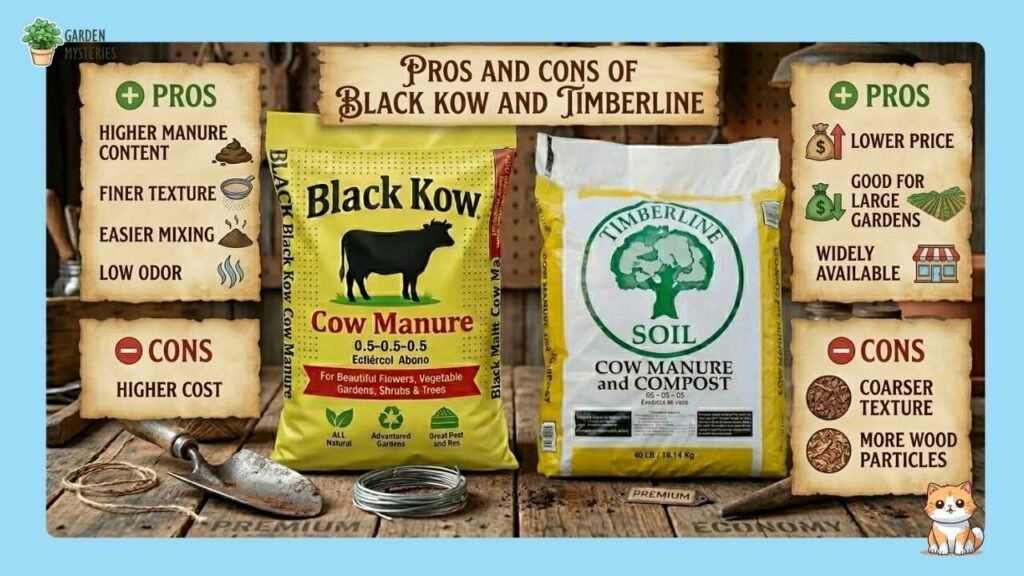
Black Kow
Black Kow is the stronger performer in most quality-focused comparisons. It consistently delivers finer texture, better mixing, and richer color. The trade-off is cost, which matters a lot for anyone managing a large garden area.
Pros:
- Higher manure content: Darker, denser, more manure-rich per bag
- Finer texture: Smooth and uniform, easy to spread and mix in
- Easier mixing: Integrates quickly without much extra effort
- Better for raised beds: Distributes evenly through the growing medium
- Better for seed starting: Fine enough to use in delicate mixes
- Low odor: Fully aerobically composted, no strong smell
Cons:
- Higher cost: Around $29 to $32 per cubic foot at most stores
- Less economical at scale: Expensive for large in-ground conditioning projects
Timberline
Timberline is a practical, budget-friendly brand that does the basic job well. It has a strong following among gardeners who need to cover large areas without spending heavily. The coarser texture is its main limitation.
Pros:
- Lower price: Around $2.50 per 40 lb bag, hard to beat on value
- Good for large gardens: Makes covering big areas affordable
- Widely available: Found at Walmart, Lowe’s, and most garden centers
Cons:
- Coarser texture: Rougher feel with more uneven particle sizes
- More wood particles: Some batches contain visible sticks or bark
- Less uniform consistency: Quality can vary between bags and batches
Which One Offers Better Value?
The answer to the Black Kow worth it question depends entirely on what you are growing and how much area you need to cover. Neither brand is automatically the better value without knowing your situation first.
For a small vegetable raised bed, spending more per bag on higher manure content makes sense. The garden area is small, the plants are food crops, and the quality difference shows up in your harvest. For conditioning a large backyard or breaking up clay soil across a wide area, buying ten bags of the affordable option at the same price as one premium bag is simply smarter math.
Choose Black Kow if:
- Quality and texture matter most to you
- You grow vegetables, herbs, or food crops
- You use raised beds or containers
- You want finer, more uniform compost
Choose Timberline if:
- Budget is your primary concern
- You need large quantities for big areas
- You are improving clay or sandy soil across a wide plot
FAQs: Black Kow vs Timberline
For raised beds and vegetable gardens, most gardeners find the finer texture and higher manure content worth the cost. For large areas, Timberline covers more ground for the same spend.
Some batches do contain visible wood particles and coarser organic material. This is typical for products made using forestry and lumber industry by-products, and it varies by batch.
Yes, it is one of the most common uses for this product. Its fine, uniform texture mixes evenly through raised bed growing medium without screening or extra prep work.
Yes. At roughly $2.50 per 40 lb bag, it is one of the most cost-effective options for conditioning large in-ground garden areas or improving clay and sandy soils across a wide space.
End Note
When it comes to Black Kow vs Timberline, each brand wins a different category. Black Kow wins on texture, manure richness, and performance in raised beds and food gardens. Timberline wins on price and practicality for large-scale soil conditioning.
If your goal is the best possible result in a small, high-attention garden, Black Kow is the stronger choice. If you need to improve a large area on a sensible budget, Timberline is a solid, honest product that does exactly what it promises. Neither brand is a bad buy when used in the right situation.
Note: Some links on this page are affiliate links. If you make a purchase through them, we may earn a small commission at no additional cost to you.